Modernizing an IoT Stack for the AI Era
A practical look at how the IoT stack changed over the last decade and why rebuilding it layer by layer matters now.
Modernizing an IoT Stack for the AI Era
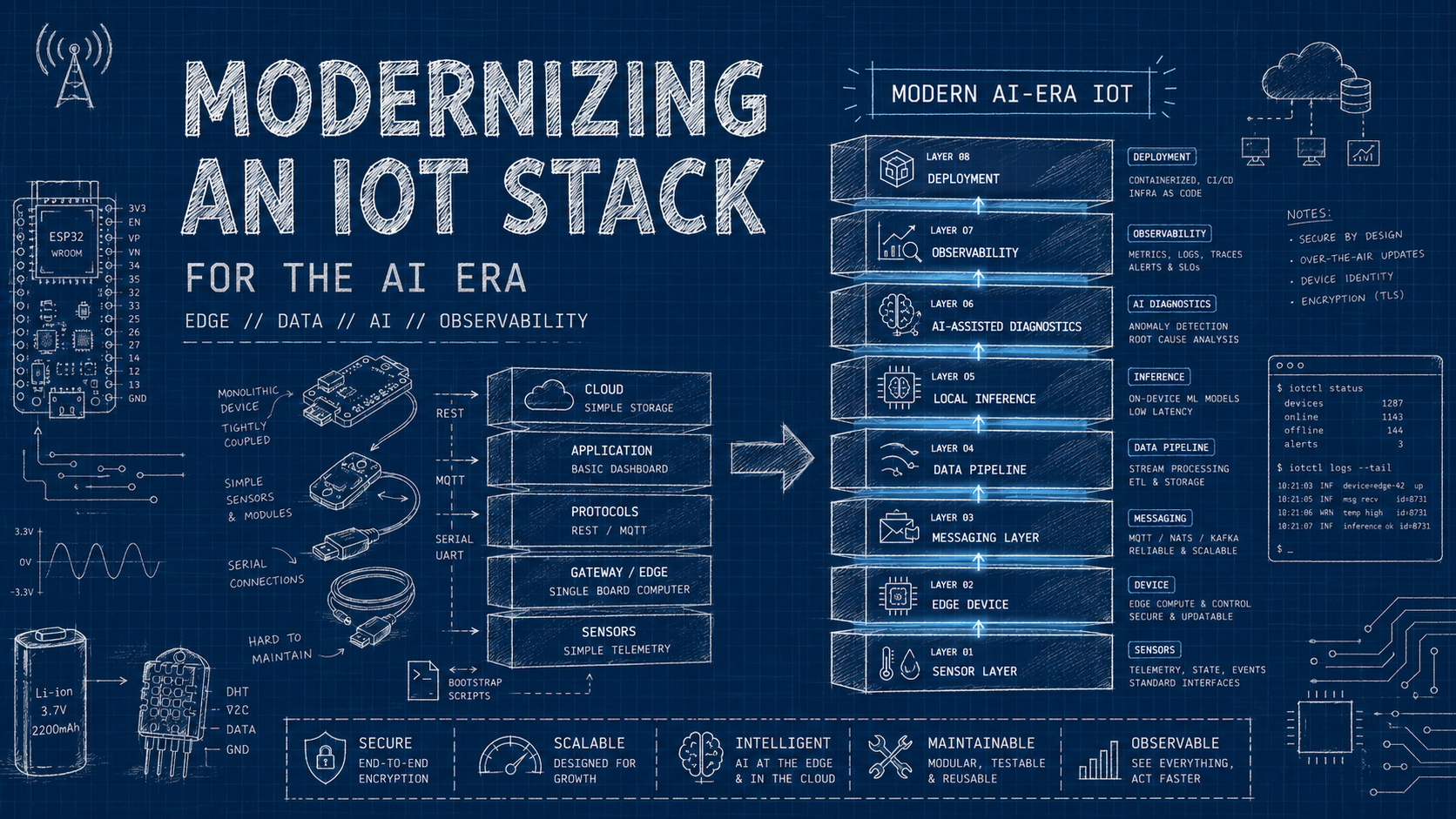
In the early 2010s, the IoT stack operated under different constraints.
Microcontrollers had tighter memory, clock, and I/O limits. Tooling was rougher. Cloud services were less mature. Teams relied on bootstrap workflows, familiar protocols, and hardware that could be made reliable enough to ship. That was not a compromise. It was the practical operating model.
Those constraints explain many of the design choices from that period. Systems were built around limited compute, uneven tooling, and a need to prove value quickly.
What worked then should not be treated as a default now.
The useful question is narrower: which parts still hold up, which should be retired, and which layers now make the system easier to build, inspect, and maintain in an AI-assisted development environment?
This series modernizes the stack one layer at a time, starting where the system becomes real.
Rebuilding the IoT Mental Model
Technical fields drift quietly. Step away long enough and the tools, defaults, and vocabulary move on. The first thing to decay is not syntax or hardware trivia. It is the mental model that explains which parts matter, how they connect, and where design judgment belongs.
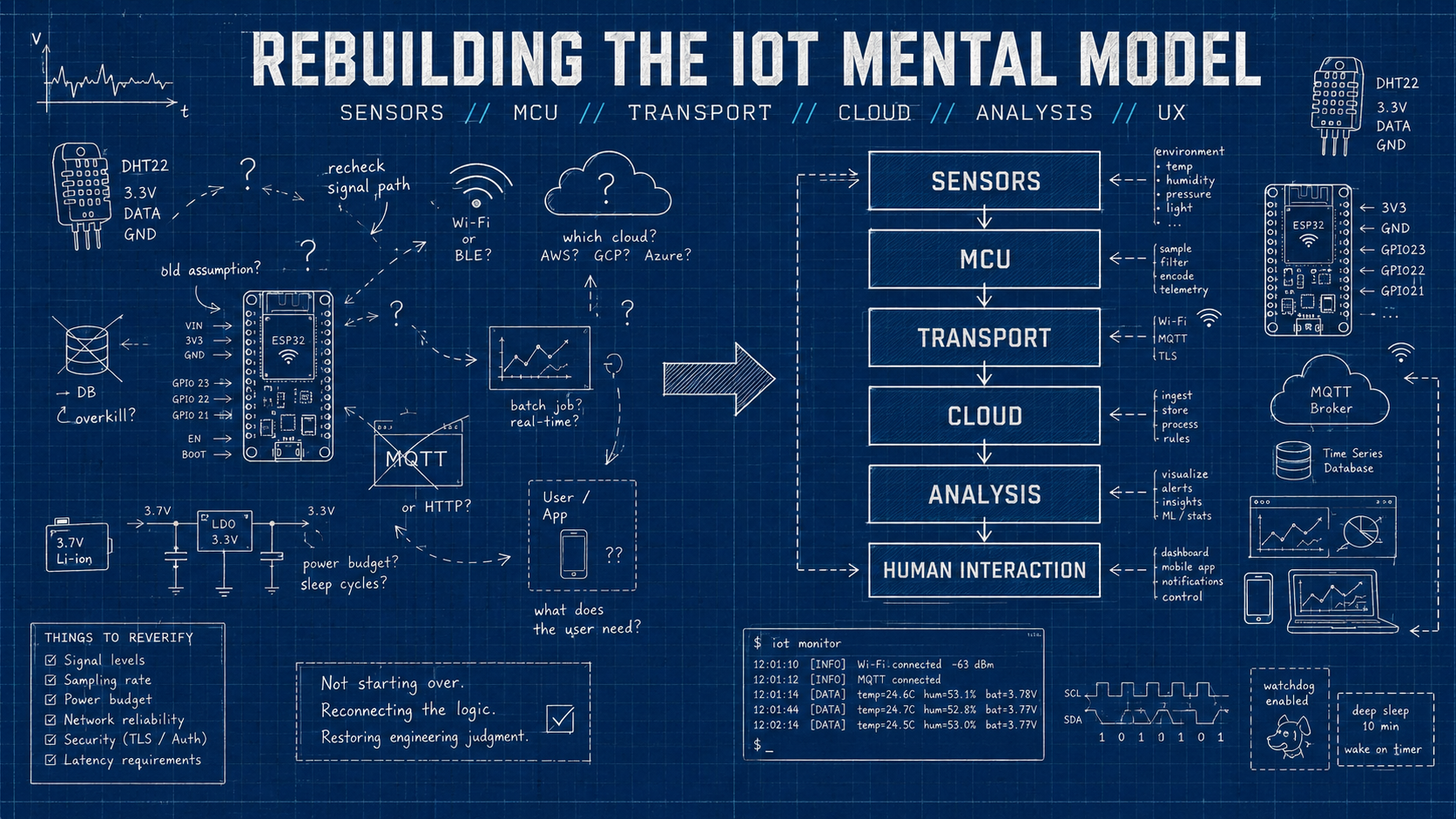
Rebuilding is not starting over. It is re-establishing a working model.
For IoT, the model spans sensor input, microcontroller logic, network transport, cloud ingestion, data handling, and operator feedback. If any layer is vague, the system becomes harder to debug and harder to trust. The work is to make the chain legible again, then update it against the current toolchain.
Lab Before Architecture
Before architecture can be evaluated, the lab has to be usable.
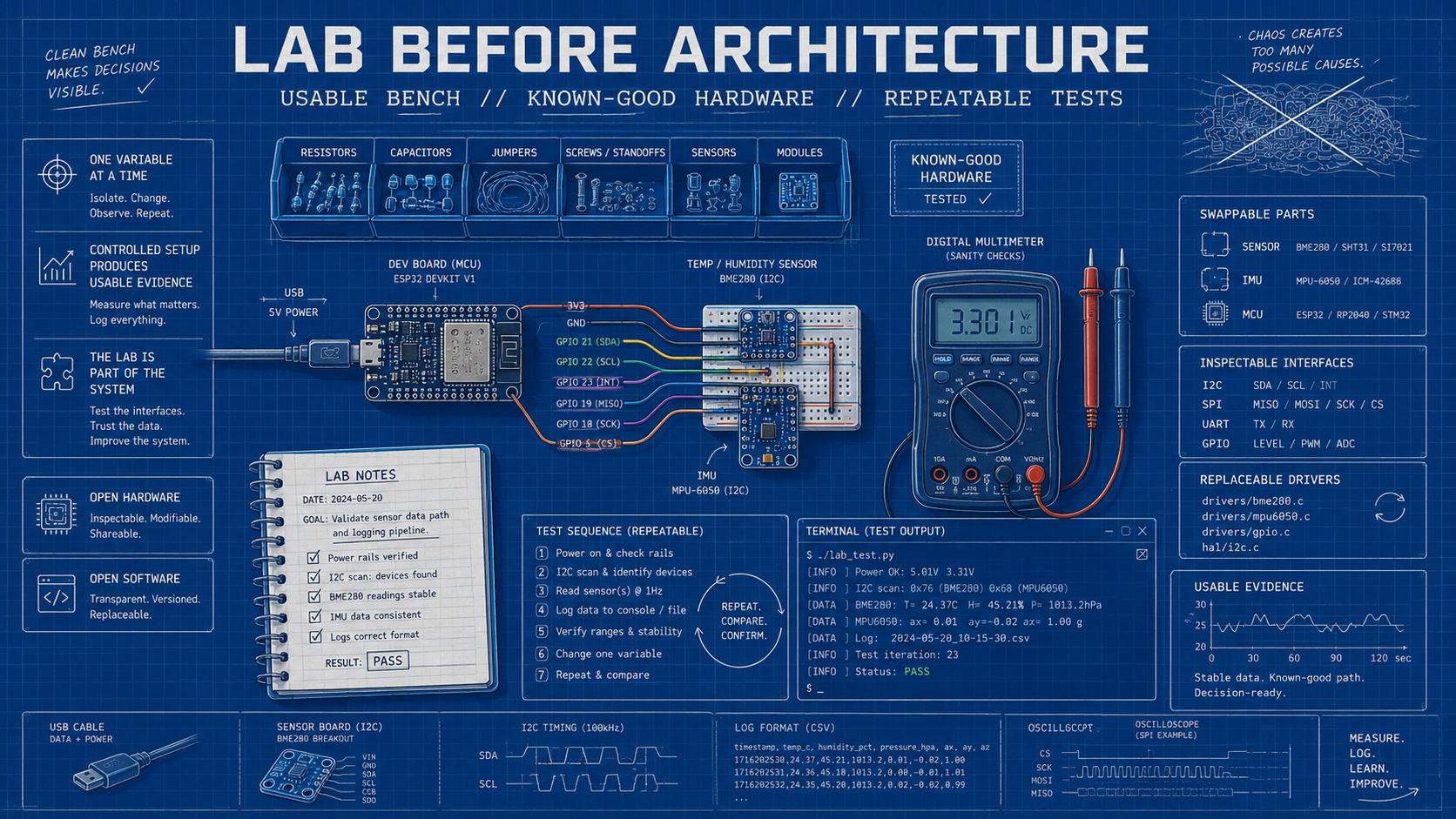
A clean bench makes decisions visible. Sensible wiring, labeled parts, known-good hardware, and reliable notes create a setup where one variable can be isolated from the next. That reduces noise and removes the temptation to debug by guessing.
The lab is not a backdrop. It is part of the system.
If the environment is chaotic, every failure has too many possible causes. If the bench is controlled, the first tests start producing usable evidence.
That is why the rebuild starts with the lab. The first requirement is a place where a test can be run, repeated, and understood. Open hardware and open software help because parts, interfaces, and drivers can be swapped or inspected before the stack commits to one vendor’s assumptions.
Microcontroller First
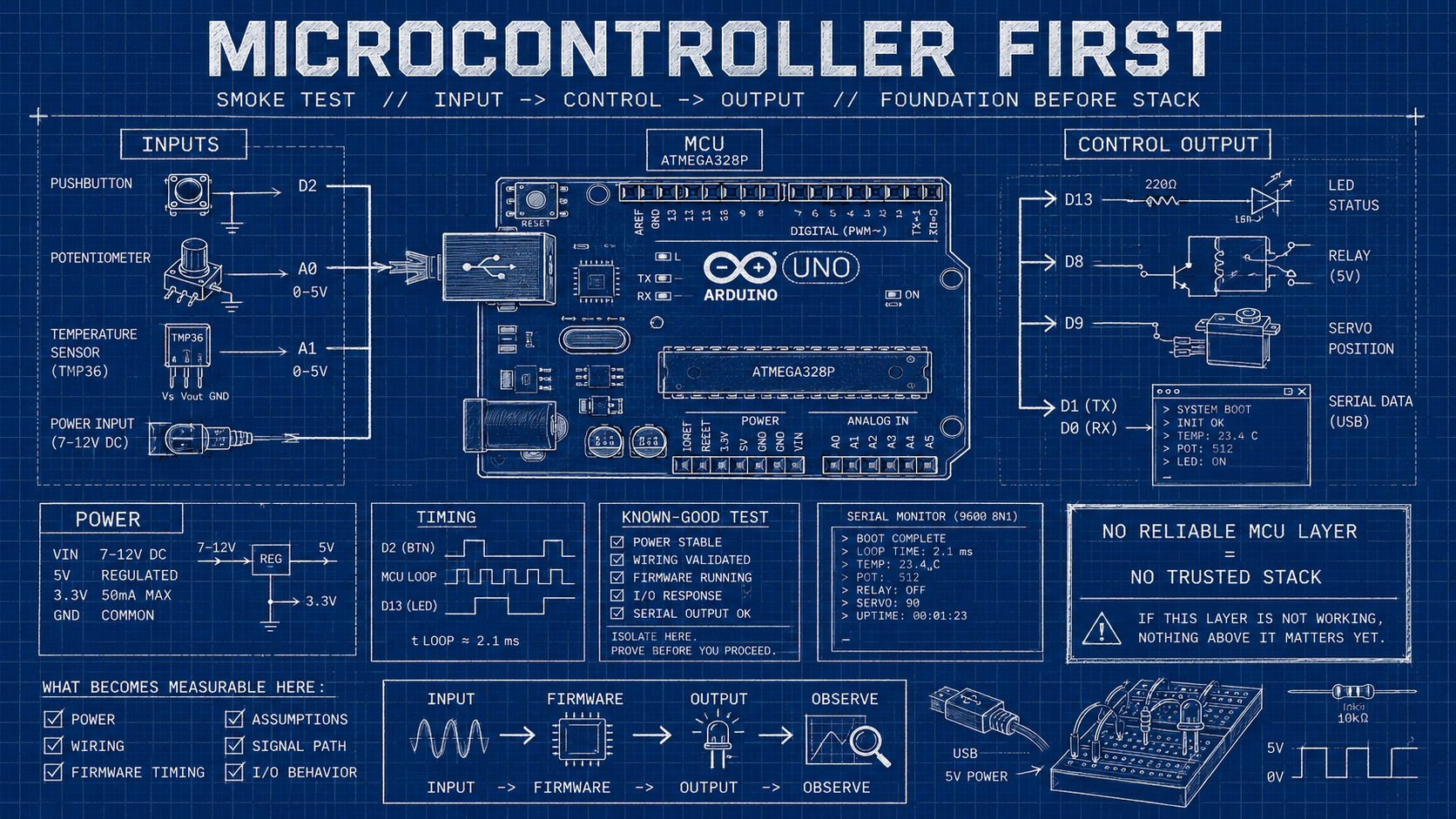
The first smoke test belongs at the microcontroller layer.
For this series, that means starting with an Arduino Uno (ATmega328 hardware). The reason is not nostalgia. It is clarity. Older, well-documented hardware exposes fundamentals without adding avoidable complexity. It is simple enough to fail loudly and familiar enough to keep setup friction low.
The point is not to blink an LED. The point is to trace the path from input to control output, then outward to connectivity and data handling. The microcontroller is where that chain becomes measurable.
If this layer is not working, nothing above it is worth pretending about yet.
This layer forces the system to behave honestly. Power, wiring, firmware timing, and assumptions show up immediately. A weak foundation has nowhere to hide.
The Stack After The Bench
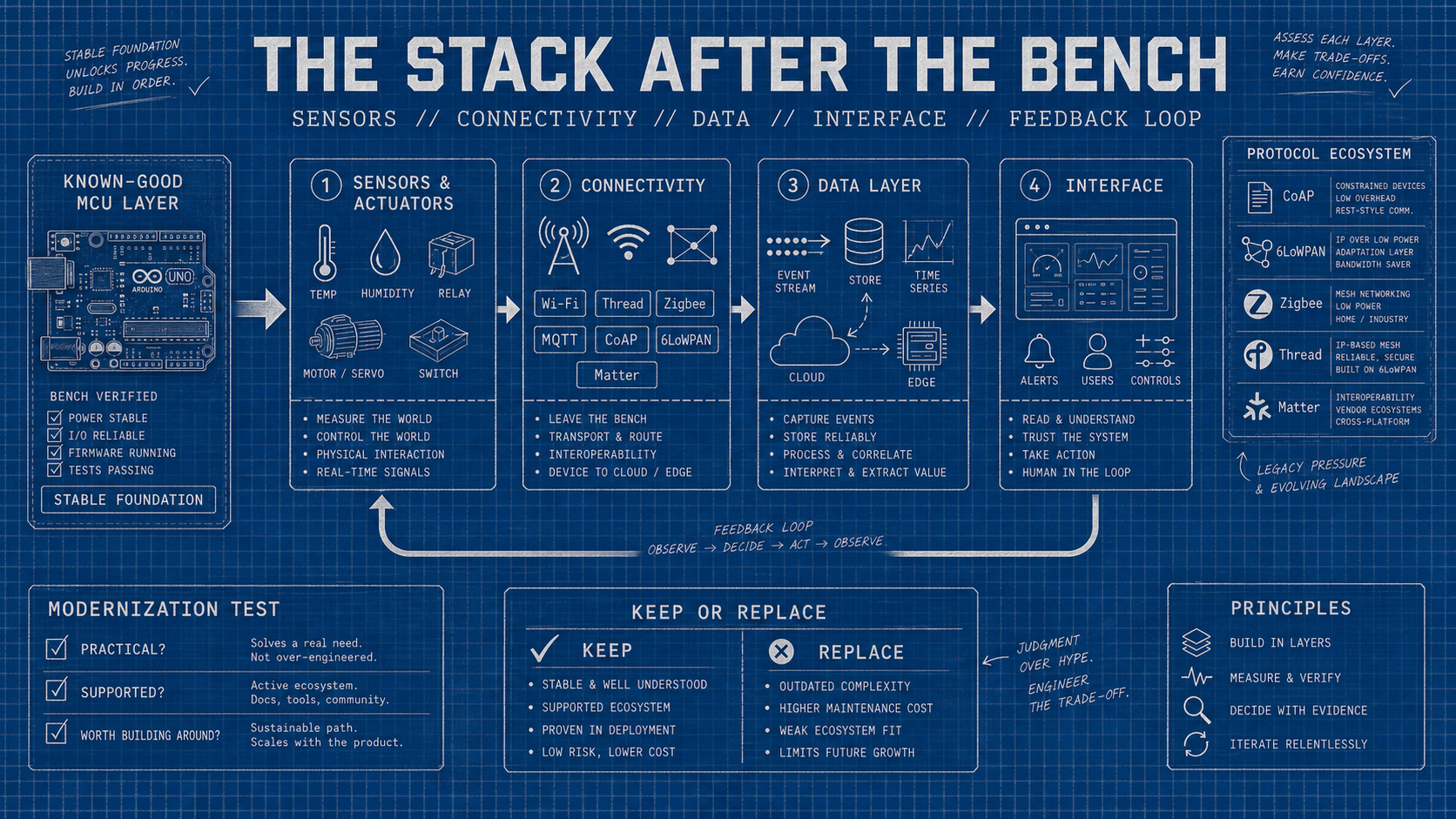
Once the microcontroller layer is stable, the rest of the system can be evaluated in order.
Sensors and actuators define what is measured or controlled. Connectivity defines how signals leave the bench. The data layer defines how events are captured, stored, and interpreted. The interface defines how a person reads, trusts, and acts on the system.
That is the real shape of IoT: not one device, one dashboard, or one cloud service, but a feedback loop.
Earlier IoT grew under uncertainty, which is why so many protocols and standards entered the stack over time. CoAP, 6LoWPAN, Zigbee, Thread, and Matter each reflect real pressure from constrained devices, mesh networking, interoperability, and vendor ecosystems. Today the question is less whether IoT can work and more which technologies remain practical, supported, and worth building around.
Modernization is not a rejection of the old stack. It is a judgment call about what still deserves space.
Some layers remain useful because they are stable and well understood. Others should be replaced because the ecosystem around them has moved on. That distinction matters because outdated complexity now carries a higher maintenance cost.
Series Path
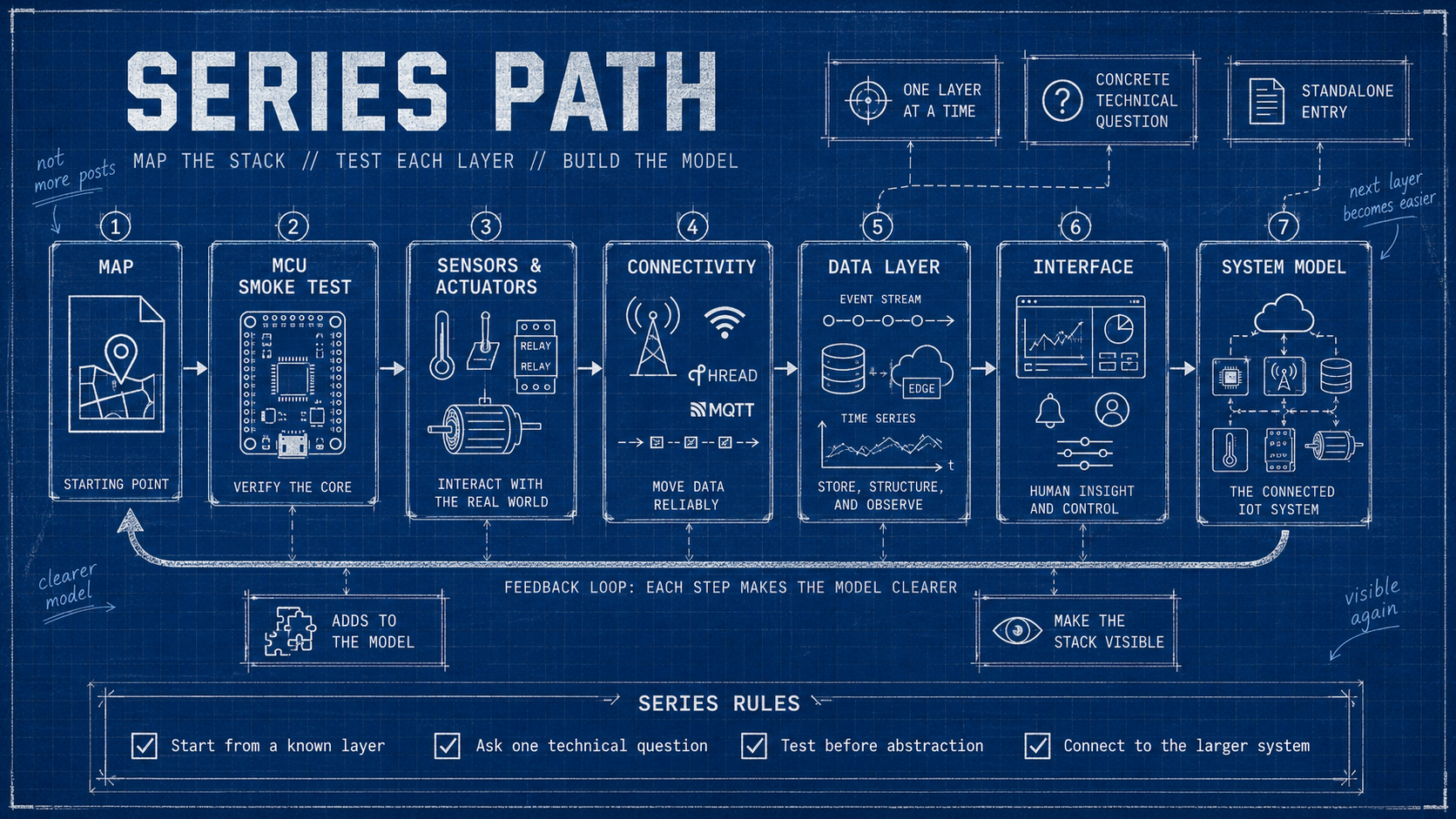
This post defines the map for the series.
The next piece focuses on the microcontroller smoke test in short video format. After that, the remaining layers follow in order: sensors and actuators, connectivity, data, and interface. Each entry should stand on its own while adding to the larger system model.
That structure matters. Each layer should answer a concrete technical question and make the next layer easier to reason about.
The point is not to post more. The point is to make the stack visible again.
Closing: Rebuild From A Baseline
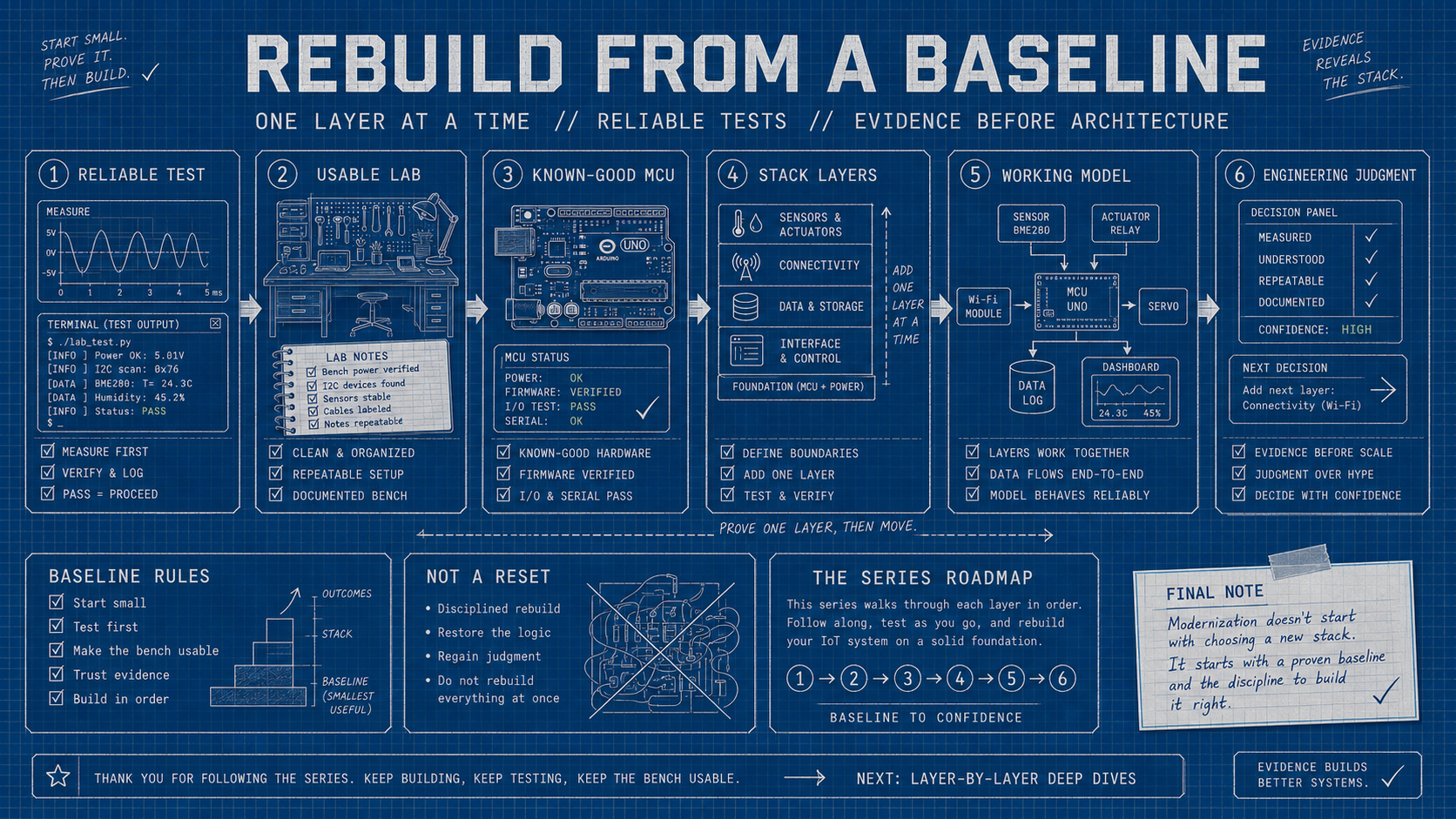
When returning to an old technical field, do not rebuild everything at once. Rebuild one layer at a time. Start with a reliable test. Make the lab usable. Let the stack reveal itself through evidence.
That is the fastest way to regain judgment without pretending the gap never happened.
The path forward is not a reset. It is a disciplined rebuild.
For anyone revisiting a field after years away, the lesson applies immediately. Modernization does not begin with the biggest architecture decision. It begins with the smallest useful baseline.
If this series is useful, follow along as the stack gets worked through in order.